The Isle of Lewis Chessmen: Viking Influence Beyond the Viking Age
Discovery
On one account, it is said that the Isle of Lewis Chessmen were discovered in 1831, partially buried in Uig Bay, on the west coast of the Isle of Lewis (in the Outer Hebrides of Scotland) by one Malcolm Macleod who had tracked a cow that had strayed from the herd. As luck would have it, he happened upon a partially buried stone case containing the chessmen along with a number of other gaming pieces.
However, the veracity of this account is contested and the actual discovery story of the pieces remains a mystery. Another account has them being found in the ruins of a monastery and yet another in a souterrain (an Iron Age stone cellar).
What we do know is that they first appeared in Exhibit at the Society of Antiquaries of Scotland in 1831 on the permission of one Roderick Rirrie.
The Pieces
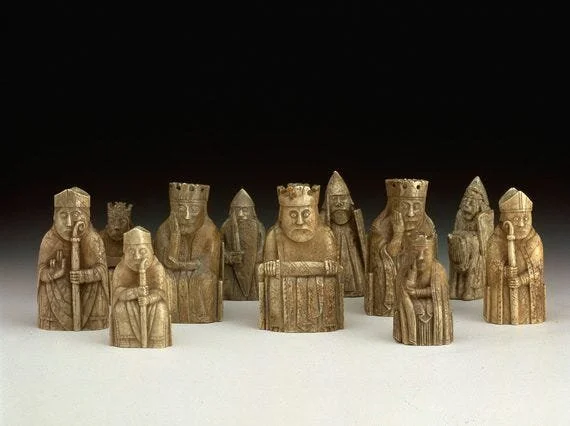
The chess pieces themselves were found among a total of 93 gaming pieces from what appears to be a total of 4 chess sets and a number of other table or board games. Some of the pieces found could have also been used in the game of Hnefatafl (a Viking Age chess-like game).
Most of the pieces are carved of walrus ivory with a few from sperm whale teeth.
Per the experts, the pieces most likely originated in Norway as a similar piece was found in Trondheim and, as well, experts believe the throne carvings to resemble carvings in medieval Norwegian churches. As well, the armor carved on the pieces is a near perfect match for Norwegian-styled armor of the time period.
A few scholars have proposed an Icelandic origin suggesting that the Walrus ivory would have come by way of Greenland to Iceland and, factoring in Iceland’s skilled carvers, this is certainly plausible. These same scholars also argue that the linguistic usage of the term “bishop” at the time was limited to Iceland and England. Further, it is suggested that, whereas “bishops” as pieces were used in chess in Iceland, in Norway the pieces were referred to as “runners” or “messengers.”
Perhaps their argument is bolstered by the discovery of a very similar piece on the northern coast of Iceland in 2010.
Significance
While the above debate may not be decided any time soon, we can be certain that the pieces were carved by Norse artisans and clearly have a Viking signature, particularly that of Norse warrior culture.
On no other piece is this, perhaps, more clear than with the rooks which are carved as berserkir, fierce Norse warriors known for fighting in a furious trance-like state, striking fear into the hearts of their enemies by biting their own shields.
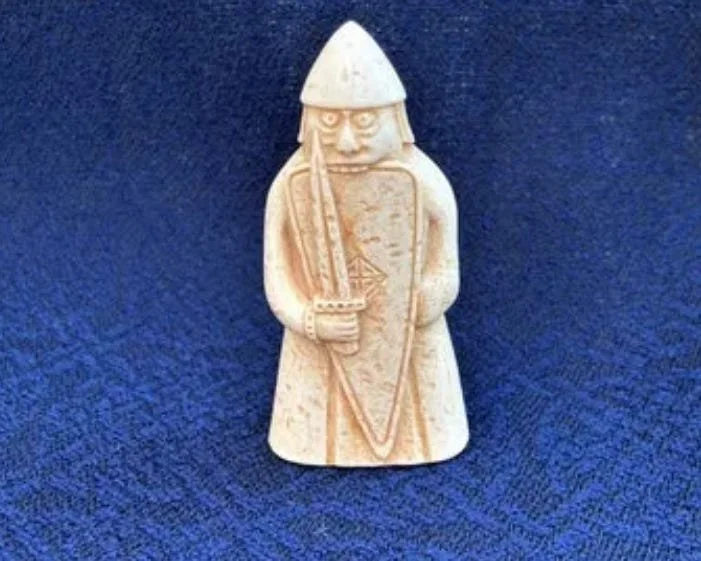
The find of the pieces provides clear evidence of a lengthy period of transition and syncretism between the pagan Norse culture and Christianity (as well as other European influence). This is evidenced by the inclusion of berserkir rooks and Catholic bishops in their mitres.
It is far too often assumed, particularly by Christians, that the “conversion” of Europe to Christianity was a one-time affair akin to a modern Protestant altar call - instantaneous. But this is far divorced from point of historical fact.
The move from paganism to Christianity was a lengthy process that took centuries. Europe wasn’t formally and finally “Christian” until the 14th century in fact. When conversions did occur, they were more often than not due to matters of economics and politics over matters of the spirit. Other “conversions” were by the sword.
If anything, the existence of such artifacts as the Isle of Lewis chess pieces confirms that what actually occurred was a form of syncretization rather than the ancestors committing a wholesale forfeiture of culture and spirituality. That never happened.
Many pagans indeed embraced certain Christian ways. But they were never fully Christian as are modern Christians today. The Catholic Church, likewise, itself embraced pagan ways. In many ways, the Catholic Church (willingly or not) preserved a core element of paganism for posterity.
Replica Sets
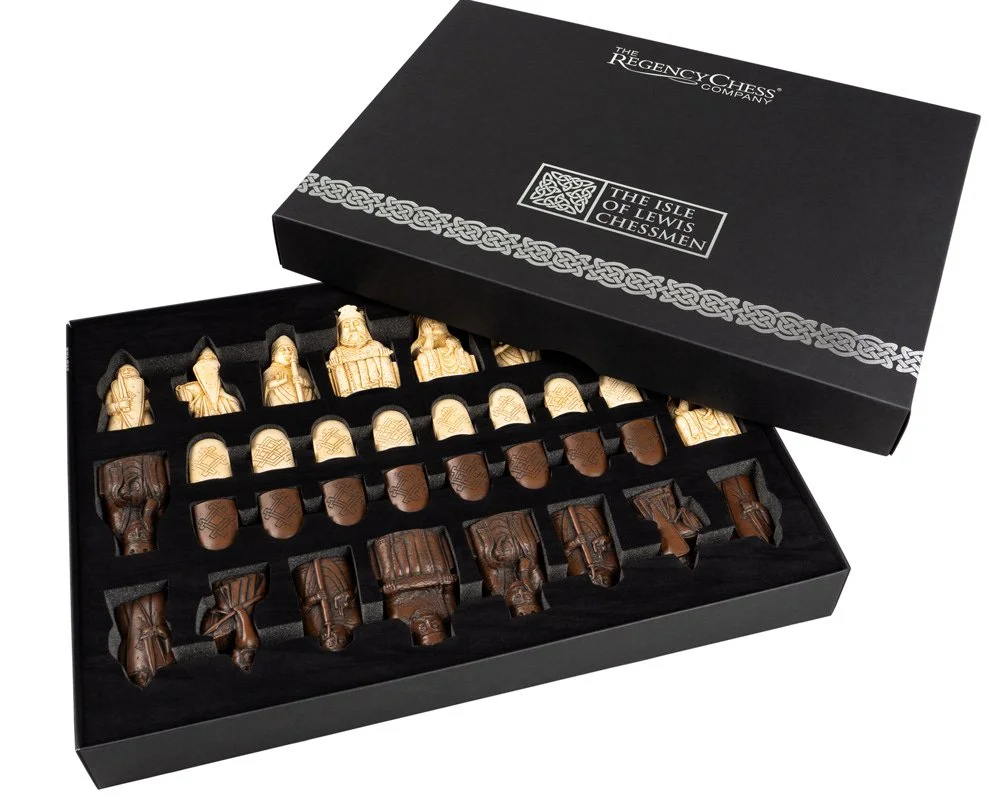
There are a number of replica sets on the market. A nice, yet affordable one can be found here. I own this set and my son and I enjoy it very much. This is a great company (I am not affiliated in any way) offering a level of customer service unheard of today. They also sell a number of Hnefatafl sets (the ancient Scandinavian or “Viking game” board game).